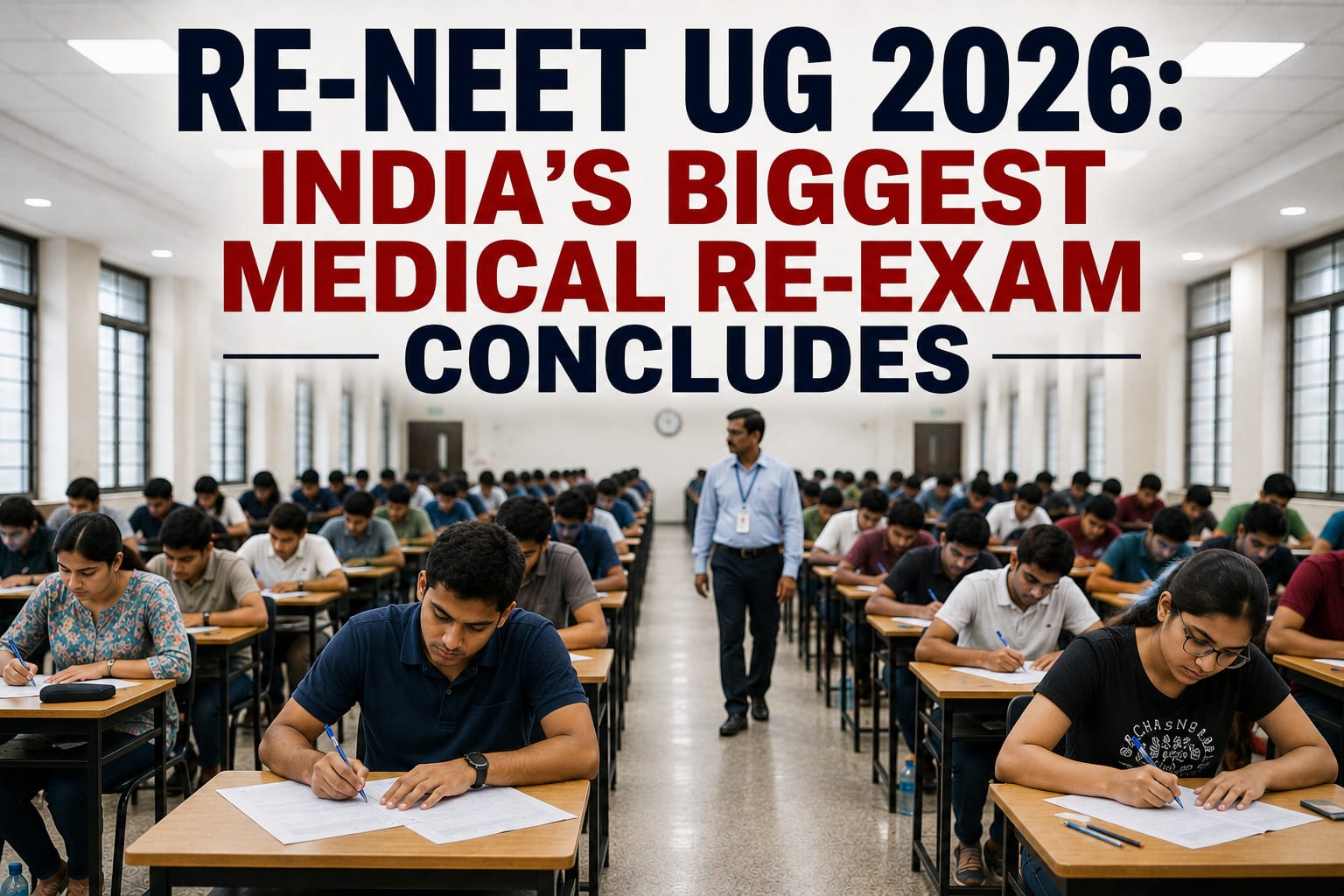
Kota, Rajasthan: India’s biggest Medical entrance examinations was held on Sunday, June 21, 2026 — a re-test of the NEET-UG 2026 that was organized after the original exam, conducted on May 3, was cancelled over a massive paper leak controversy that shook the country’s education system to its core.
More than 22.8 lakh (2.28 million) aspiring doctors descended upon 5,440 examination centres spread across 551 cities in India and 14 cities abroad, with the exam conducted in pen-and-paper mode from 2:00 PM to 5:15 PM — with an additional 15 minutes granted to all candidates, bringing the total to 195 minutes.
The stakes could not have been higher. For most of these students, this was not just another exam. It was a second chance — after months of anxiety, protests, court battles, and a scandal that implicated exam officials, professors, and a nationwide cheating network.
NEET PAPER: MODERATE OVERALL, BUT PHYSICS DREW BLOOD
As students streamed out of centres across the country at 5:15 PM, a broadly consistent picture emerged: the paper was moderate in overall difficulty, but Physics was the section that separated the well-prepared from the rest.
|
Overall Verdict: Moderate difficulty. Paper was doable but time-consuming. Physics and Chemistry emerged as the toughest section in the paper. No out-of-syllabus questions reported. Class 11 topics carried higher weightage. Some questions are doubted and bonus may into action in final result. |
A student exiting a centre in Delhi told reporters: “The exam was quite moderate. Physics was lengthy — a little bit tougher than last time. Biology was good and Chemistry was moderate.” This assessment was echoed across cities.
From Chennai, a candidate named Tarun said: “I did well but let’s see. The exam was tougher than last time.” In Mumbai, where nearly 50,000 students sat the exam, Sudha Shenoy, a parent, summed it up: “The overall difficulty level was moderate to tough, with many students finding it more challenging than the previous test.”
Subject-wise Difficulty Breakdown
|
Subject |
Difficulty Level |
Key Features |
Good Attempts (Expected) |
|
Physics |
Tough |
Lengthy numericals, JEE-level concepts, multi-step calculations |
30–35 / 50 |
|
Chemistry |
Moderate |
NCERT-based, Organic easy, Physical Chemistry tricky numericals |
38–42 / 50 |
|
Biology |
Easy to Moderate |
Mostly NCERT direct, Genetics, Physiology, Ecology, Reproduction |
78–82 / 100 |
|
Overall |
Moderate |
Class 11 questions had higher weightage; no out-of-syllabus questions |
148–158 / 200 |
Physics — The Toughest Hurdle
Physics was unanimously rated the most difficult and time-consuming section of the paper. Students reported lengthy, multi-step numerical problems that demanded deep conceptual understanding — some even described select questions as requiring JEE-level clarity, though nothing was technically out of syllabus.
“Physics will decide the cutoff for the Re-NEET exam,” noted experts from leading coaching institutes. Students who relied only on formula-based preparation found themselves struggling, while those with strong conceptual grounding fared better.
Chemistry — Toughest in the History of Exam
This time Chemistry paper was the toughest one in the history of NEET entrance exam. Organic Chemistry was largely straightforward and NCERT-direct, while Physical Chemistry included several tricky numerical problems. Statement-based and assertion-reasoning questions were designed to test genuine conceptual knowledge rather than rote memorization. Most students described it as manageable with thorough NCERT preparation.
Biology — The Scoring Lifeline
For most students, Biology was the section that provided relief and an opportunity to recover marks lost elsewhere. The vast majority of questions came directly from NCERT, with strong coverage of Genetics, Human Physiology, Ecology, Plant Physiology, and Reproduction. Around 76–78 questions out of 100 were considered readily doable by students with solid NCERT command.
SCENES FROM THE GROUND: TEARS, PROTESTS AND PLEAS
Across the country, exam day unfolded with scenes that captured the immense emotional weight of this examination on millions of young lives and their families.
Bengaluru: A Student Tries to Climb a Gate
In one of the most striking visuals of the day, a girl student in Bengaluru was caught on camera attempting to climb the outer railing of a locked examination centre gate in a desperate bid to enter after being denied entry for arriving late. She eventually climbed down. Three female candidates had arrived at RC Government College at 1:32 PM — just two minutes after the gate closed at 1:30 PM — after being stuck in traffic caused by a Congress rally in the city. Their distress drew bystanders and sparked outrage on social media.
Mumbai: Protests Outside Parel Centre
In Mumbai’s Parel area, emotional scenes unfolded outside Maharshi Dayanand College as several candidates missed their examination. Parents and guardians staged protests, arguing that given the national significance of the exam and the hardship already endured, authorities should have shown more flexibility. Nearly 50,000 students appeared in Mumbai alone.
Ajmer, Rajasthan: The Burqa Controversy
A NEET aspirant, Kulsum Bano, who had travelled from Beawar to Ajmer, was initially denied entry for wearing a burqa, before eventually being permitted after a standoff. She told reporters: “When I took the exam on May 3rd, I was in the same attire. If the NTA has permitted us, these people cannot stop us. It is shameful that they are messing with 18-year-olds like this.”
UP’s Moradabad: Google Maps Sends Students to Wrong Location
In Moradabad, Uttar Pradesh, some candidates missed the exam entirely after Google Maps directed them to the wrong location. Their appeals for re-entry were unsuccessful, adding to the day’s catalogue of distressing moments.
Delhi: ‘We Were On Time, But They Refused’
A student in Delhi alleged that she reached the exam centre at exactly 1:30 PM but was still not allowed to enter, with authorities claiming the gate had already been shut. “We reached the examination centre at 1:30 PM, but the authorities refused to open the gate,” she said.
Telangana: A Mother’s Desperate Plea
Perhaps the most heart-wrenching image came from Telangana, where a mother was seen begging at the feet of security guards to allow her daughter entry to the examination centre — a moment that went viral and drew widespread condemnation of the rigid enforcement of entry rules on such a high-stakes day.
BACKGROUND: WHY WAS THE NEET RE-EXAM HELD?
The Re-NEET 2026 was necessitated by one of the biggest examination fraud scandals in India’s history. The original NEET UG 2026 exam, conducted on May 3, 2026, for over 2.27 million students, was cancelled on May 12 after investigations revealed that a pre-circulated guess paper had an overlap of up to 120–140 questions with the actual exam paper.
The leak was traced through Sikar, Rajasthan, where a chemistry teacher named Shashikant Suthar blew the whistle after comparing circulated material with the real paper. The CBI took over the investigation on May 12, arresting key accused including Pune-based chemistry professor P.V. Kulkarni and biology professor Manisha Gurunath Mandhare, who were running special classes where exam questions were allegedly dictated.
Perhaps most damning was the arrest of Manisha Sanjay Havaldar, headmistress of a Pune school and NTA-appointed subject expert, who confessed to recalling Physics questions from memory and sharing them with a student. These were then circulated via a messaging app. CBI raids recovered question papers, NTA identity card copies, and cash from her residence.
Union Education Minister Dharmendra Pradhan admitted to a “breach in the command chain” and announced plans to shift NEET to computer-based testing from 2027. The CBI also found evidence suggesting the NEET UG 2025 paper had been compromised by the same network.
SECURITY MEASURES FOR THE RE-EXAM
To prevent a repeat, the NTA implemented unprecedented security for the June 21 re-exam. Paper setters, translators, moderators, and team members were held at an undisclosed secure location in the lead-up to the exam. The exam was conducted across 5,440 centres in 551 cities under heightened scrutiny.
The NTA also launched the MANAS Mental Health Helpline (14416) to support students experiencing exam-related stress and anxiety during preparation — an acknowledgement of the psychological toll the prolonged uncertainty had taken on aspirants.
EXPECTED CUTOFF AND WHAT COMES NEX
|
Cutoff Estimate: Given the moderate difficulty level, experts suggest the cutoff may be slightly lower than or equal to 550 marks. Final estimates will depend on the complete paper analysis and the number of candidates who appeared. |
With the exam now over, candidates will await the official answer key from the NTA. Rank predictor tools and cutoff estimates will help aspirants gauge their admission chances. The results, once declared, will determine admissions to MBBS, BDS, and other undergraduate medical and dental courses across India.
For the lakhs of students who sat this exam — many of whom had already appeared on May 3 and spent weeks in uncertainty — the conclusion of the paper brings both relief and cautious hope. Their journey to medicine is not over, but the hardest chapter of 2026 may finally be behind them.